

 Fonctionnement - Simulation model of melting ice fields and glaciers
1. Ice fields melting
- In the lower basin, place 2 ice cubes to symbolise the ice field.
- Fill the basin very gently until the top without overflowing it.
- Do not move the model or shake it!
- Wait patiently for the ice cubes to completely melt.
Observations :
Before the ice cubes have melted, it is noticeable that only a very small part of them is above the level of the sea: most of it remains under water. This is why the expression 'the tip of the iceberg' is used when we want to say that something is only a very small visible part of a much bigger whole.
Once the ice cubes have melted, the level of the ocean will not have risen because when they melted they lost exactly the same volume of water that they had gained when they froze.

Most scientists thus consider that the melting of sea ice and icebergs will not have an effect on the level of the oceans (unlike the melting of land ice).Although this is largely true, it turns out that there is actually an increase effect, even if it is minimal. Recent scientific publications show that what is true for fresh water is not true for salt water. Indeed, the volume of water displaced will have increased by 2.6% after the melting of the ice. This slight increase is due to the difference in volume between equal masses of fresh water and salt water.This does not call into question the general principle of the experiment which shows that the melting of ice already floating on the oceans will have very little effect on the level of the seas. 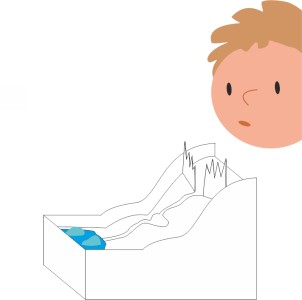
2. Melting of glaciers
- Following experiment 1, the lower basin is filled to the brim but does not overflow.
- Place 2 ice cubes behind the mountains. They will symbolise a terrestrial glacier.
- Do not move the model or shake it!
- Wait patiently for the ice cubes to completely melt.
Observations :
Once melted, the glacier water will flow through the rivers into the lower basin representing the ocean.The water will overflow and flood the lower part of the model.This illustrates the consequences of rising sea levels.Habitable land will be covered with salt water, making it uninhabitable for humans and their crops.
before it overflows, the water in the container may create a kind of dome. This is due to surface tension. To reduce this phenomenon, a few drops of dishwashing liquid can be added to the water in advance. 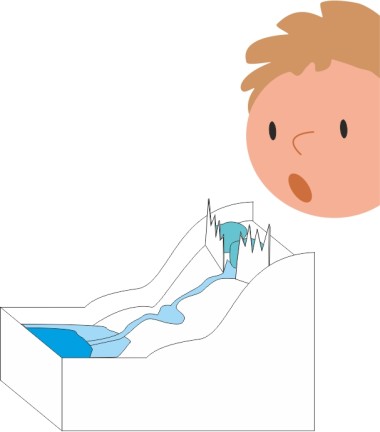


 |  |  |  |  |  |  |  |  |  |  |
