

 Bioclimatic greenhouse
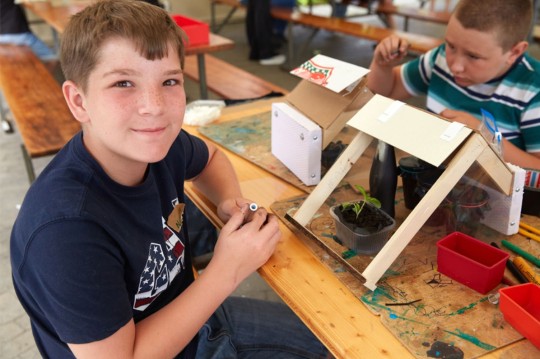
A bioclimatic greenhouse stores solar energy during the day and releases it at night.
It ensures night-time temperatures that are significantly higher than those that can be achieved in a 'classic' greenhouse, which, during the cold period (November to April), allows frost to be avoided without the use of energy (or very little) apart from that of the sun.
If the aim is to avoid temperatures that are too low, the bioclimatic greenhouse also limits overheating in summer thanks to solar protection and openings that can be adjusted according to the internal temperature.
The bioclimatic greenhouse is a good example of the passive use of solar energy, i.e. without the use of solar collectors.
Modern houses also use passive solar energy, with large south-facing windows to take advantage of solar heat in mid-season and winter, very well-insulated walls to limit energy loss, and effective shading systems (overhangs, blinds, trees) to prevent overheating in summer.
This DIY project allows you to build a mini-greenhouse with all the elements necessary for bioclimatic operation.
| Date | 18.11.2025 |
| Auteur | Martin |
| Organisme | info-energie |
| Traducteur | Martin |
| Finalité | Produire de la lumière ou de la chaleur |
| Domaine | Biologie végétale Energie Développement durable |
| Langue(s) | français english |
| License |  |
